
The first article in this series focused on digital presence as part of how a business is represented, understood, and evaluated. The second focused on AI as a business tool rather than a business mind: useful when directed, constrained, and verified, but less useful when treated as a substitute for judgment. This final part is where those two ideas meet.
A recent example came through the development of a two-panel advertisement for a Chinese trade show brochure. On paper, the task was simple enough: create an ad. In practice, it involved several different kinds of work at once — reference analysis, visual design, brand consistency, cross-cultural communication, translation, and verification. From concept to finished piece, the full process moved in two days.
This was also not a routine placement. It would be The Turman Group’s first appearance at the event, and for many of the Chinese businesses seeing it, a first introduction to the organization itself. That raised the standard for the work. The ad needed to be visually clear, professionally credible, and appropriate to a setting that was not local to us.
More Than a Graphic
The assignment was not simply to make something attractive.
The ad needed to fit inside the visual environment of the Qingdao International Furniture Fair guide rather than look like an American ad dropped into someone else’s publication without regard for the setting. It needed to communicate what The Turman Group is, why its structure matters, and why that structure is relevant to Chinese buyers and partners. It also needed to remain consistent with the larger digital identity already being built elsewhere: the same brand markers, the same vertical integration narrative, and the same use of real company imagery rather than embellished or artificial visuals. In the earlier article on digital presence, that broader effort was described as the development of a coherent system that helps a business represent itself clearly and accurately across touchpoints.
In that sense, the advertisement was not separate from digital presence. It was another expression of it. The QR code pointed back to the website. The design needed to carry the same structural story already being used elsewhere. The images needed to look like the company, not like a generic forest-products collage.
Starting With the Reference Material
Before the ad itself was built, the QIFF guide was reviewed as reference material. The point was not only to gather ideas. It was to understand the communication environment the ad would have to sit inside.
That read was fairly clear. The stronger ads were generally visual-first and relatively text-light. They relied on strong imagery, short statements, booth numbers, and contact or QR information rather than dense explanation. That pattern shaped the design from the beginning. Instead of trying to explain everything in copy, the visuals needed to do a large share of the work.
This was one of the first places AI became useful, and not in a generative sense. The guide was analyzed through a back-and-forth discussion to identify patterns, test early impressions, and reduce the risk of producing something that would feel visually out of place in that setting. The work began with evaluation rather than generation.
Cultural Questions Were Part of the Design Problem
The work also involved something more than layout.
This was a Chinese trade show guide aimed at Chinese buyers. That introduced cultural questions that could not be treated as secondary. Some of those questions were visual. How much text would feel normal in that setting? Should any English be used alongside the Chinese? How could The Turman Group and its value to Chinese buyers be communicated within a limited amount of text?
Some of those questions were interpersonal. As part of the project, I needed to communicate with our Chinese representative whom I did not have a pre-existing relationship. AI helped to navigate cultural nuances and protocols not normally present in American business. The role of AI was not to imitate cultural fluency. It was to help identify where cultural protocol might matter, clarify what was appropriate, and prevent careless assumptions from slipping into the communication.
Translating Meaning, Not Just Words
That same issue applied in translation.
In email communications with the Chinese rep, it was important to be able to have a detailed discussion about the content of the ad, and how to present it effectively. The challenge was having a discussion between non-native speakers of each other’s language. The goal with AI in this case was not literal translation. A word-for-word version would have been easier to produce, but it would not have solved the real problem. What needed to carry across was intent: appreciation for the feedback, recognition of the guide’s format, respect for the audience, and a clear explanation of what the ad was trying to communicate about The Turman Group.
The process used was explicitly message-based rather than word-based. The message, tone, and subtext were explained first. Then the translation was shaped around that, with the aim of preserving professionalism without stiffness, respect without awkwardness, and clarity without flattening the meaning. That approach was described directly in the translation discussion: the purpose was to retain context and intent rather than convert each phrase literally.
The resulting Chinese reply reflected that approach:
感谢您的反馈。我看了去年的展会导览,注意到里面的广告整体都比较简洁,主要是用有冲击力的画面、简短明确的信息,再配上联系方式。因此,我在设计这则广告时,也希望尊重这种版式和表达方式。
Thank you for your feedback. I reviewed last year’s exhibition guide and noticed that the advertisements within it were generally quite minimalist—primarily utilizing impactful visuals and concise, clear messaging, accompanied by contact details. Therefore, in designing this advertisement, I aimed to respect and adhere to that specific layout and style of presentation.
And later:
我想传达的是,我们能够从林地管理、采伐、锯切、加工,到装船发运,进行全流程协同与管控。这意味着更完整的质量控制、更强的产能保障,以及更稳定可靠的供应能力。
What I wish to convey is that we are capable of achieving end-to-end coordination and control across the entire process—from woodland management, harvesting, and sawing to processing and final shipment. This translates into more comprehensive quality control, enhanced production capacity assurance, and a more stable and reliable supply capability.
That translation was not simply accepted because an AI produced it. Since getting the message right the first time mattered, it was cross-checked through multiple systems and translation pathways. The point of that second pass was simple: if several independent tools brought the Chinese back into essentially the same English meaning, that suggested the core intent had survived the language shift. In the review that followed, the translation was described as semantically stable and unlikely to be misunderstood at the core-message level.
Building the Ad
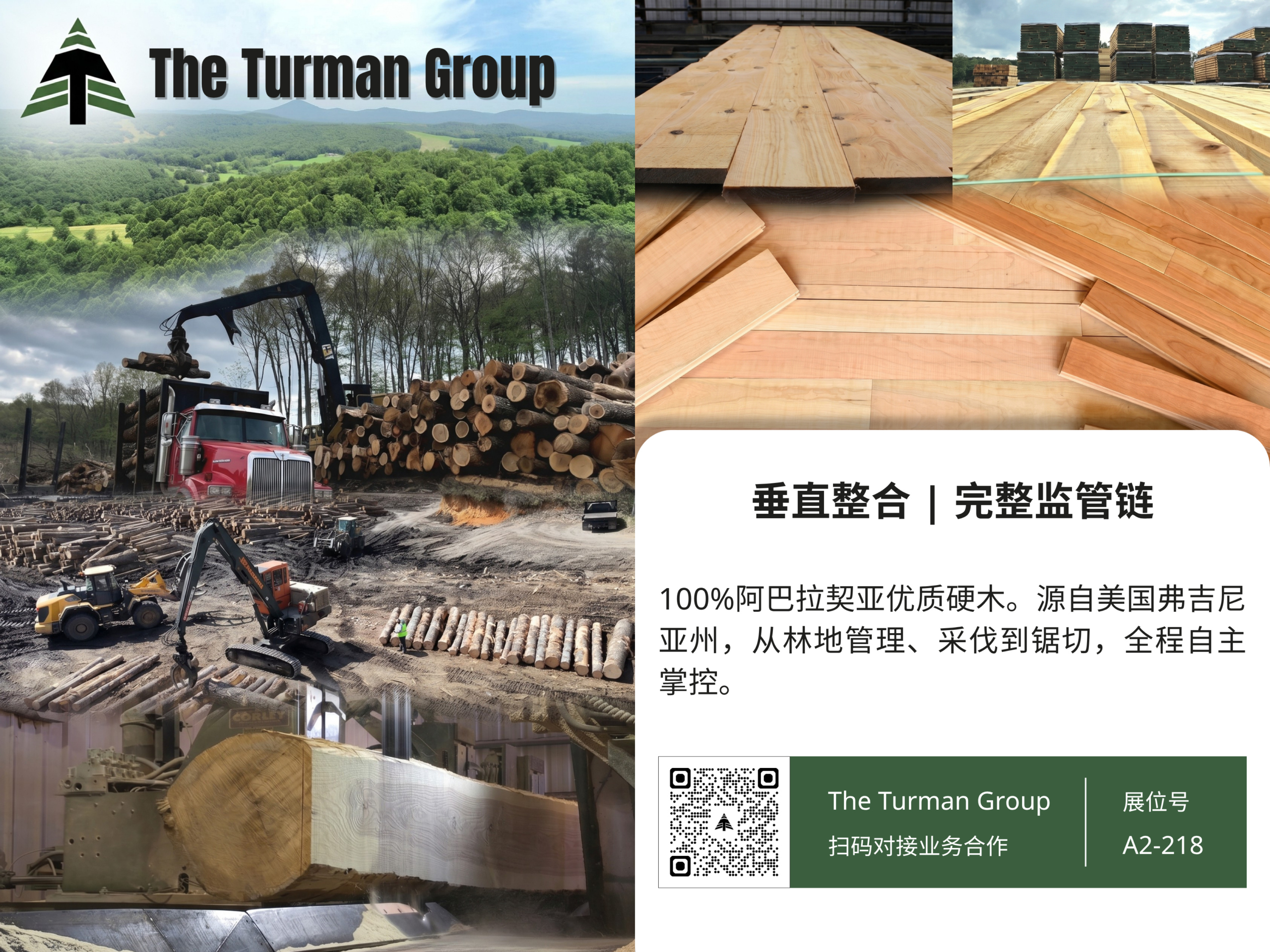
The visual side of the ad was developed as a two-panel narrative.
Panel 1 was meant to show the beginning of the chain: Appalachian hardwood forestland, timber harvest, log-yard activity, and sawmill operations. Panel 2 continued that progression into lumber preparation, export readiness, and finished hardwood flooring. Across both panels, the larger message was the same one already being emphasized elsewhere: vertical integration and complete chain-of-custody control. The first panel was framed explicitly around “Vertical Integration and complete chain of custody,” with the second continuing the narrative from sawmill operations through export and finished product.
AI image generation was used here, but under narrow, explicit constraints.
The prompt for Panel 1 did not ask for a generic forest-products image. It specified the exact image set, the order in which those images should be used, the top-to-bottom progression, the rule against stylization, the rule against duplication, and the instruction not to add text or extra elements. In practical terms, the prompt was doing compositing direction: use these real images, in this sequence, with this visual flow, and do not wander outside those bounds.
The prompt for Panel 2 was different because the second panel had a different job. It was less about beginning the chain and more about carrying the viewer from processed lumber to finished product while still leaving room for the brochure’s text block and contact information. In the earlier design discussion, that problem was described directly: the second panel needed to preserve the visual flow of the images while also making space for a structured text area.
Those prompt structures are part of the point. The model was not being asked to invent the concept. The source material, sequence, visual logic, realism standard, and design constraints were already defined. AI was being used to turn that structure into draft panels more quickly than manual compositing alone would likely have allowed.
Human-Led, AI-Assisted
That phrase can sound abstract until there is a case attached to it. In this case, it meant several different things at once.
It meant using Gemini to help search and evaluate cultural and format context. It meant using ChatGPT to help shape message-based translation and tone. It meant using Nano Banana 2 to combine real company footage into draft ad panels. It meant using multiple AIs and translation tools to pressure-test critical outputs rather than trusting any one of them on its own.
It also meant using AI before the visible output stage. Some of the prompts and workflows used with AI were themselves shaped with AI’s help. That same pattern has shown up in other kinds of work as well: developing the prompts that guide later research, designing repeatable workflows for recurring tasks, building custom website plugins and CMS components when off-the-shelf tools were bloated or mismatched, and helping organize and support public-facing projects such as the Virginia Lumber Cup. In those cases, AI has not only been used to generate words or visuals, but to help define the structure of the work itself.
That broader pattern is easy to miss if AI is discussed only at the level of output. Sometimes the visible result is an ad. Sometimes it is a translation. Sometimes it is a prompt, a workflow, a plugin, a page, or a solution to a problem that was difficult to define clearly at the start.
What the Case Shows
Taken together, the case shows a use of AI that is broader than image generation and narrower than authorship.
The tools supported several different kinds of work:
- Analysis of reference material to understand how the surrounding guide communicated,
- Identification of cultural considerations in both audience-facing design and direct business communication,
- Translation of intended meaning and tone rather than literal wording,
- Generation of draft visuals from real company images under tight constraints,
- And validation of important outputs through multiple systems rather than one-pass trust.
If digital presence is a communications system rather than a decorative extra, then a brochure ad tied back to the website, brand identity, and structural narrative is part of that system. If AI is most useful when the human remains central, then a project involving reference analysis, translation, prompt design, revision, and verification is one example of what that looks like in practice.
The same overall logic extends beyond this single project. Evaluating, testing, discovering, generating, and validating can apply just as easily to problems that are harder to identify at first. In some cases, the difficult part is not making something. It is first determining what the real problem is, what information matters, what assumptions are safe, and what needs to be checked before a solution can be trusted.
For The Turman Group, this has meant using AI to help evaluate and redefine digital presence through the restructuring of websites and social media. It has also meant using AI to help conceptualize and build customized tools, including VBA-based Excel applications and company-specific WordPress plugins, when off-the-shelf options were either too limited or too bloated for the actual need. The same overall logic has also been applied to the analysis of industry materials such as the Hardwood Market Report and, more recently, to the conceptual development, organization, and promotion of the Virginia Lumber Cup. Throughout, the foundation of the work was the same: AI assisted human problem solving and creativity.
Examples of AI use for Problem Solving and Creativity:
These attached files are samples of actual discussions, workflows, and prompts used in this and similar work.