A U.S. pallet company may first encounter the European Union’s Packaging and Packaging Waste Regulation through a customer shipping palletized products into Europe. This article addresses one specific transaction: a U.S. pallet company supplies wooden pallets to a U.S. customer, and that customer uses them to ship palletized goods to the European Union. The pallets enter the EU as packaging and come within the PPWR framework.
The central documentation question is which company PPWR identifies as the Manufacturer, not simply who built the pallet. That role determines who is responsible for the conformity assessment, technical documentation, and EU Declaration of Conformity—and who instead supplies the supporting information.
This article addresses only wooden pallets used as transport packaging in that U.S.-to-EU supply chain. It does not address pallets used only within the United States, the separate role of the EU importer, extended producer responsibility, or detailed instructions for satisfying every PPWR requirement.
What PPWR Is and Why It Includes Wooden Pallets
Regulation (EU) 2025/40 is the European Union’s Packaging and Packaging Waste Regulation, commonly called PPWR. It entered into force on February 11, 2025, and applies from August 12, 2026. The Regulation establishes requirements across the life cycle of packaging, including environmental sustainability, labeling, waste prevention, reuse, and recycling. [1, Arts. 1, 71]
Article 2 applies PPWR to “all packaging, regardless of the material used.” Article 3 defines transport packaging by its function: facilitating the handling and transport of sales units or grouped sales units while preventing damage. Annex II identifies wooden packaging as Category 20 and expressly lists pallets, boxes, and crates as examples. [1, Arts. 2–3; Annex II, Table 1]
A pallet supporting goods through shipment performs that transport function. Manufacturing and selling it in the United States does not change its classification when it accompanies goods placed on the EU market.
What PPWR Generally Requires of Pallet Packaging
PPWR establishes sustainability and labeling requirements in Articles 5 through 12. Depending on the packaging and applicable date, they address substances, recyclability, recycled content in plastic packaging, packaging minimization, reuse, and labeling or information. Article 15 requires the Manufacturer to place only conforming packaging on the market. [1, Arts. 5–15]
The requirements must be supported by a conformity assessment, technical documentation, and an EU Declaration of Conformity. The detailed contents and compliance methods for pallets will be discussed in a future article. The question here is who carries responsibility for that evidence: the Manufacturer or the Supplier.
“Manufacturer” Is a Defined PPWR Role
In ordinary U.S. business language, the company assembling the pallet is the pallet manufacturer. PPWR uses Manufacturer as a defined regulatory role. Article 3(1)(13) begins with the person that manufactures packaging or a packaged product, but—subject to a limited micro-enterprise exception—assigns the role to a person that has it designed or manufactured “under its own name or trademark.” Another visible trademark does not change that rule. [1, Art. 3(1)(13)]
The Commission Guidance confirms that the regulatory Manufacturer is not necessarily the company that physically produces the packaging. It considers the role in designing or manufacturing the packaging and the trademark or branding, and states that there is only one Manufacturer in the supply chain. [2, Topic 2, p. 5]
For transport packaging, the Commission says the Manufacturer will normally be the company that manufactures the packaging. The result changes when the transport packaging is “clearly branded by the user” through that user’s name or trademark. In that case, the user is the Manufacturer. [2, Topic 2, p. 5]
The Guidance interprets selected PPWR provisions but does not replace, add to, or amend the Regulation. Binding interpretation of EU law remains with the Court of Justice of the European Union. [2, p. 1]
PPWR contains limited rules for a branded party that qualifies as a micro-enterprise. Article 3’s exception depends on the packaging supplier being in the same EU Member State, while Article 15(12) addresses a supplier located in the Union. Neither condition exists when both parties are in the United States. A supply chain involving an EU supplier requires a separate analysis. [1, Arts. 3(1)(13)(b), 15(12)]
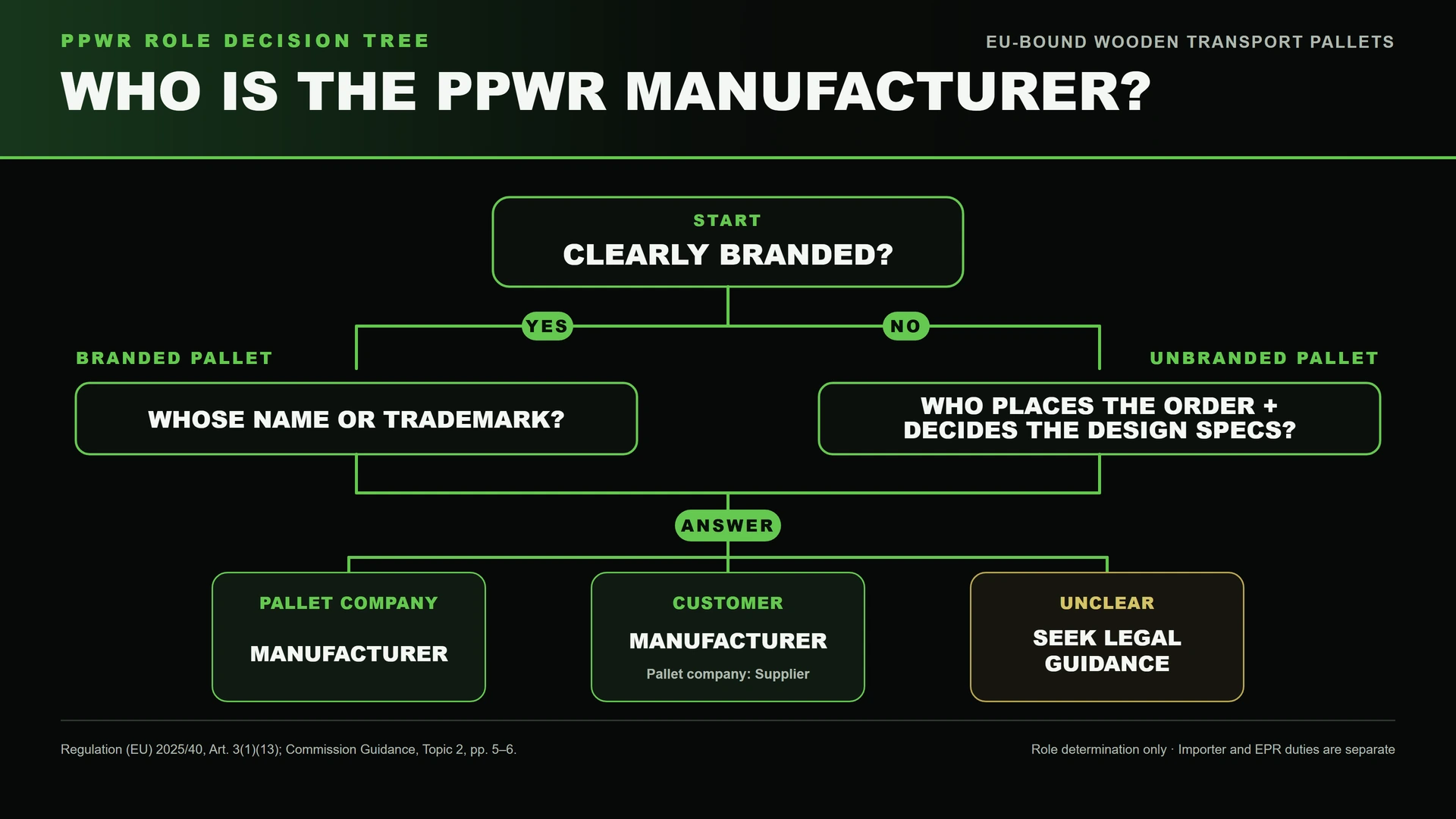
For the transaction addressed here, the analysis starts with clear branding.
Decision 1: Is the Pallet Clearly Branded with a Party’s Name or Trademark?
The Commission’s test concerns clear branding through a name or trademark. If a marking does not clearly establish the branded party, follow the unbranded or ambiguous path.
- The pallet is clearly branded with the pallet company’s name or trademark: The pallet company is normally the PPWR Manufacturer because it manufactures the transport packaging under its name or trademark. [1, Art. 3(1)(13)][2, Topic 2, p. 5]
- The pallet is clearly branded with the customer’s name or trademark: The customer is normally the PPWR Manufacturer because the Guidance assigns that role to the user when transport packaging clearly carries the user’s branding. [2, Topic 2, p. 5]
- The pallet carries multiple or ambiguous markings: Another visible trademark does not by itself change the determination. The question remains which person had the pallet designed or manufactured under its own name or trademark. If the facts do not establish that person, additional legal advice may be necessary. [1, Art. 3(1)(13)(a)]
If the pallet is not clearly branded, the Commission provides a second decision point.
Decision 2: Who Places the Order and Decides the Design Specifications?
For packaging without a trade name or brand name, the Commission says the Manufacturer could be the packaging supplier or the person placing the packaged products on the market. The decisive criterion is “who places the order and decides on the design specifications.” [2, Topic 2, p. 6]
Applied to the defined pallet transaction:
- The customer places the order and decides the pallet’s design specifications: The customer is the PPWR Manufacturer. The pallet company supplies packaging to that Manufacturer.
- The pallet company places the order for production and decides the pallet’s design specifications: The pallet company is the PPWR Manufacturer under the Commission’s normal rule for transport packaging.
- One party places the order while the other decides the design specifications, or the records do not establish both facts: The Guidance does not expressly allocate the role. Review the purchase order, drawings, specifications, approvals, branding instructions, and design-change authority, then obtain legal advice if the Manufacturer remains unclear.
The Regulation and Guidance direct this determination toward clear branding and, for unbranded packaging, the party that places the order and decides the design specifications.
If the Pallet Company Is the PPWR Manufacturer
Article 15 assigns the conformity obligations to the Manufacturer. Before placing packaging on the market, the Manufacturer must carry out the applicable conformity assessment, or have it carried out, and prepare the Annex VII technical documentation. Once conformity is demonstrated, the Manufacturer “shall draw up an EU declaration of conformity.” [1, Arts. 15, 38–39; Annex VII]
The Commission describes the Manufacturer as the “sole economic operator bearing legal responsibility” for compliance. Another party may perform the assessment or draft documents on its behalf, but that does not transfer legal responsibility. [2, Topic 2, p. 6]
When the pallet company is the PPWR Manufacturer, it is therefore responsible for the conformity-documentation process and the EU Declaration of Conformity for the pallet.
If the Pallet Company Is the PPWR Supplier
Article 3(1)(16) defines a Supplier as a person supplying packaging or packaging material to a Manufacturer. When the U.S. customer is identified as the Manufacturer, the pallet company’s role is Supplier for this purpose. [1, Art. 3(1)(16)]
Article 16 requires the Supplier to provide the Manufacturer with the information and documentation needed to demonstrate conformity, including applicable Annex VII technical documentation required under or pursuant to Articles 5 through 11. It may be supplied in paper or electronic form. [1, Art. 16]
Supplier status does not mean no documentation is required. It changes the purpose of that documentation: the pallet company provides supporting information and evidence, while the customer uses it to demonstrate conformity and draw up the Declaration.
The Documentation Path Follows the Role Determination
For this U.S.-to-EU pallet supply chain, the Regulation and Commission Guidance establish the following sequence:
- Confirm that the pallet will be used as transport packaging for goods entering the EU.
- Determine whether the pallet is clearly branded with the pallet company’s or customer’s name or trademark.
- If the pallet is not clearly branded, identify who places the order and decides its design specifications.
- Assign the single PPWR Manufacturer role using those facts.
- Apply Article 15 to the Manufacturer and Article 16 to the Supplier.
The documentation responsibility follows the role determination. Physical production alone does not always make the pallet company the PPWR Manufacturer, and purchasing pallets does not automatically leave the Declaration with the pallet company. Under the Commission’s guidance, clear branding and the combined ordering and design facts determine which obligation applies. [2, Topic 2, pp. 5–6]
How Blackberry Pallet Assesses Its PPWR Supplier Role
Blackberry Pallet has reviewed its own role using the PPWR and the Commission’s Guidance for the customer-directed pallet programs described in this article. The Commission explains that the regulatory role is not determined solely by who physically produces the packaging. When packaging does not bear a trade name or brand name, its decisive criterion is who places the order and decides the design specifications. [2, Topic 2, pp. 5-6]
Blackberry Pallet does not maintain a catalog of pallet designs that we market under the Blackberry Pallet name or trademark. Our work begins with customer-provided requirements. Customers provide the exact dimensions, tolerances, components, assembly requirements, quantities, and delivery schedules. We build those pallets just in time and adjust supply to their production cycles.
Those specifications can change. Customers have updated their pallet requirements to account for handling equipment, load characteristics, and performance needs. In some cases, they have asked us to rework previously delivered pallets to meet revised requirements. This operating history shows that our customers do more than select a quantity from a catalog: they direct the specifications we build to.
Taken together, these facts are why Blackberry Pallet assesses itself as the PPWR Supplier for these customer-directed pallet programs. This statement is limited to Blackberry Pallet’s assessment of its own role. It does not assign a PPWR role to any customer or replace another company’s assessment of its own obligations.
Supplier status still carries an information obligation under Article 16. To meet that obligation, Blackberry Pallet has prepared a PPWR Supplier Information Statement and applicable supporting technical documentation. Depending on the pallet, that documentation includes technical information from our pallet nail and fastener suppliers and paint safety data sheets when paint is used. The PPWR Supplier Information Statement is Blackberry Pallet’s method of organizing and providing that information; it is not a form specified by the Regulation. [1, Art. 16]
Disclaimer
This article provides a source-based explanation of the Regulation and Commission Guidance for the limited transaction described above. It is not legal advice. Where the facts do not produce a clear Manufacturer determination, the parties should seek advice addressing their specific contractual and supply-chain arrangement.