If you export your goods to the EU or perhaps you supply a customer who does, you may have heard this or will soon:
As an importer under PPWR, we are required to demonstrate compliance and maintain appropriate supporting documentation.
To support our compliance obligations, please provide the following for each applicable packaging type:
- Declaration of Conformity in accordance with Annex VIII of PPWR.
- Technical documentation demonstrating that a conformity assessment has been carried out in accordance with Annex VII of PPWR.
Before simply downloading someone else’s Declaration of Conformity template and form to fill out, it is very important to first understand what PPWR is and what is your company’s actual legal obligation. PPWR is not just a document that needs to be printed. There are technical requirements that must be met, documented evidence to be gathered, and specifically defined roles of responsibilities of who is obligated to provide what documents.
Your company may be required to issue a Declaration. You may need to obtain Declarations from your suppliers. You might have to do both.
The following article is based solely on the actual EU PPWR regulatory text, the EU Commission’s published Guidance on PPWR, and the official FAQ. We provide this article to help others better understand PPWR and their obligations and how to meet them, but does not constitute legal advice. Each concerned company should read the source material for themselves and seek appropriate expert and legal advice before determining their own PPWR obligations.
PPWR reaches the Packaging around the product
Regulation (EU) 2025/40 is the European Union’s Packaging and Packaging Waste Regulation, commonly called PPWR. It establishes requirements for Packaging placed on the EU market and addresses subjects such as restricted substances, recyclability, recycled content, minimization, reuse, labeling, traceability, technical documentation, and Declarations of Conformity. PPWR generally applies from 12 August 2026, although individual requirements and supporting measures have their own dates. [1, arts. 1, 2, 5–12, and 71]
PPWR regulates the Packaging, not the bowls, lumber, or other commercial product inside it. Boxes, pallets, shrink wrap, bubble wrap, protective sheeting, strapping, and dunnage can be Packaging because they contain, protect, handle, deliver, or present the product. Packaging used to facilitate handling and transport and prevent damage is Transport Packaging. [1, art. 3(1), points (1) and (7)]
“Placed on the market” does not mean that every piece of Packaging must be sold separately. PPWR defines “making available on the market” as supplying Packaging—empty or with a product—for distribution, consumption, or use on the Union market during commercial activity, whether paid or free. “Placing on the market” is the first such making available. [1, art. 3(1), points (9)–(10)]
For imported packaged products, the Commission FAQ says placement is generally considered to occur when the goods are declared for release for free circulation, while recognizing that it can occur earlier. The transaction and customs arrangement matter. [3, sec. X, question 12]
In other words, Packaging is placed on the EU market when that packaging becomes part of the EU’s commercial activity – the Packaging continues to support the product as it moves between companies, it is removed and sent to recycling, it is discarded as waste and enters waste management systems, and/or it is reused/repurposed to support other products or another commercial activity.
One shipped unit can require several Declarations

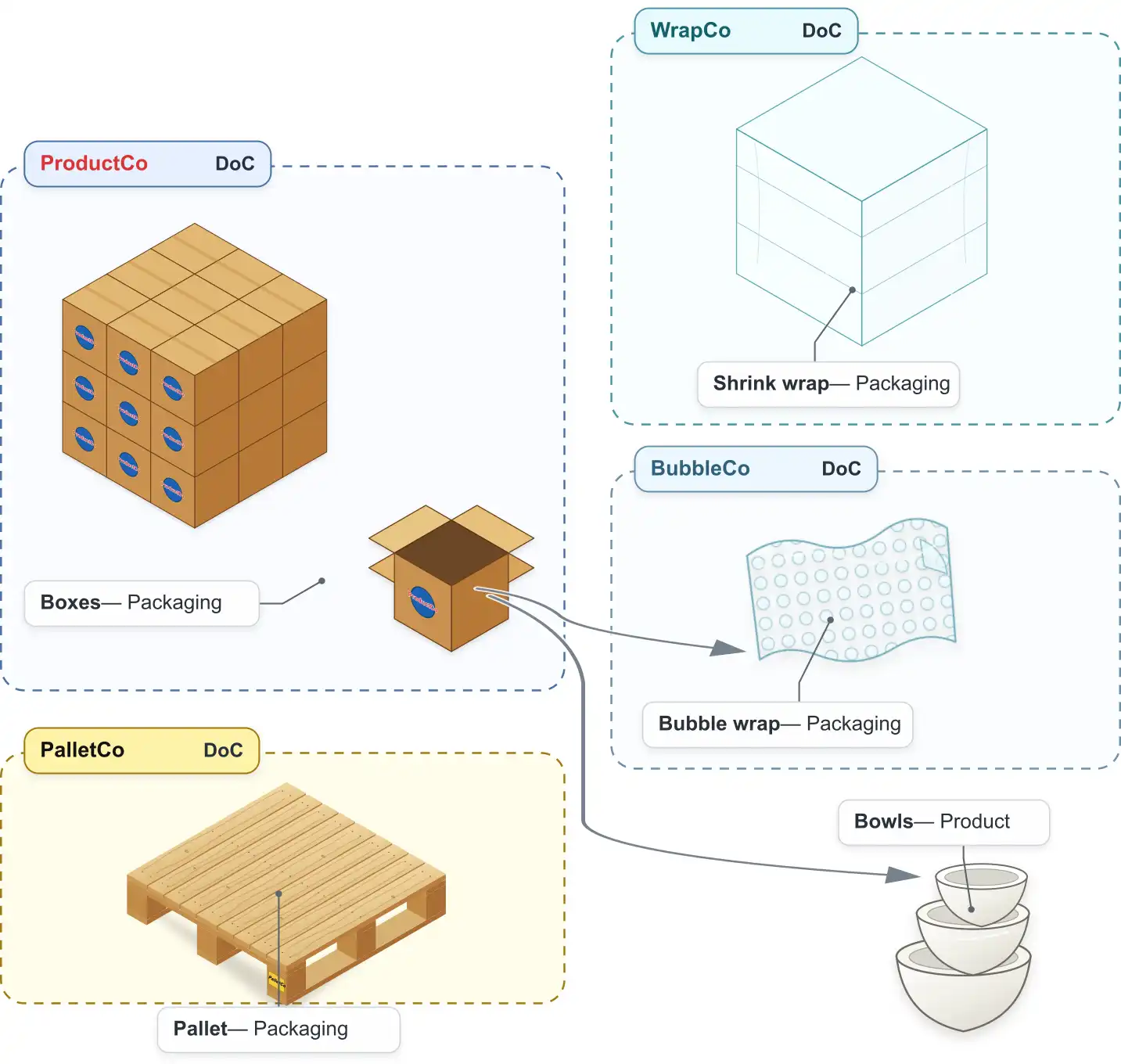
The assembled load looks like one commercial unit. The exploded view reveals the underlying documentation structure: ProductCo boxes, a PalletCo pallet, WrapCo shrink wrap, and BubbleCo bubble wrap. This example does not create a universal rule for every palletized shipment. It shows why a single shipment-wide statement may be inadequate.
The Commission FAQ recognizes that one shipment can contain Packaging from multiple Manufacturers. It also distinguishes separate Transport Packaging types from components assessed together as part of one Packaging unit. Pallets, wrappings, and straps can require separate assessments and Declarations, while a smaller component that makes up part of a packaging type – such as nails or staples in a pallet or to secure sheeting – may instead be supported within the technical documentation for a defined Packaging unit. The actual configuration and the Manufacturer’s documented assessment determine the boundary. [3, sec. II, question 5; sec. XV, questions 5 and 11]
In short, start with identifying the product, identify each Packaging type, and then identify the documentation that applies to each one and who is the party responsible for it.
The Manufacturer is responsible for the DoC
A PPWR DoC is not a generic supplier certificate or a statement that “everything we sell is compliant.” It is the Manufacturer’s formal declaration that their identified Packaging conforms to the applicable PPWR requirements.
Before placing Packaging on the market, the Manufacturer must complete the required conformity assessment, or have it performed on its behalf, and prepare the Annex VII technical documentation. After conformity has been demonstrated, the Manufacturer draws up the EU Declaration of Conformity using the Annex VIII structure. By issuing it, the Manufacturer assumes sole responsibility for the Packaging’s conformity. This includes Manufacturers who sell their packaging products solely within the United States, but then that packaging is used by other companies to ship their products to the EU. [1, arts. 15(2), 38, and 39; Annexes VII–VIII]
A properly authorized representative may draft a DoC on the Manufacturer’s behalf, but that does not transfer the Manufacturer’s legal responsibility. The Manufacturer must also establish and maintain the technical basis for conformity, using information that Suppliers are required to provide. [1, arts. 16 and 17; 2, topic 2; 3, sec. X, question 9]
This matters with products such as strapping and shrink wrap. A purchaser may know the supplier name and invoice number but not the chemical composition, additives, recycled content, manufacturing controls, tests, calculations, or traceability details needed for the assessment. Those records explain why a downstream company should obtain the applicable Manufacturer-issued DoC rather than create an unsupported substitute.
For any given packaging type, there is only one Manufacturer who is required by PPWR to issue the Declaration of Conformity. Generally, the person who manufacturers a packaging product under their brand or trade name, is the Manufacturer. Shrink wrap, banding straps, branded pallets, branded boxes, are all examples of packaging products whose Manufacturer must issue a DoC.
The same method applies to bundled lumber
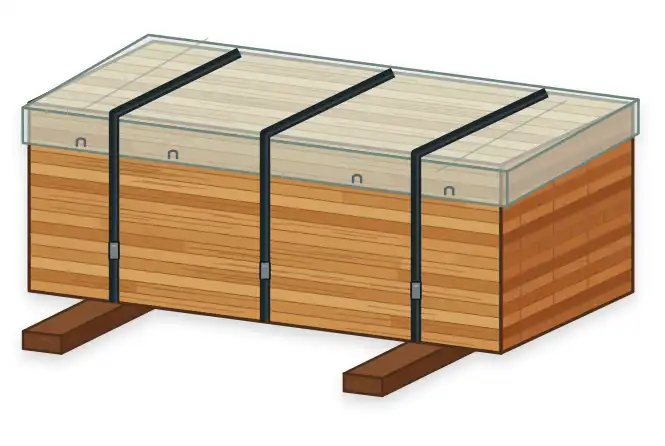
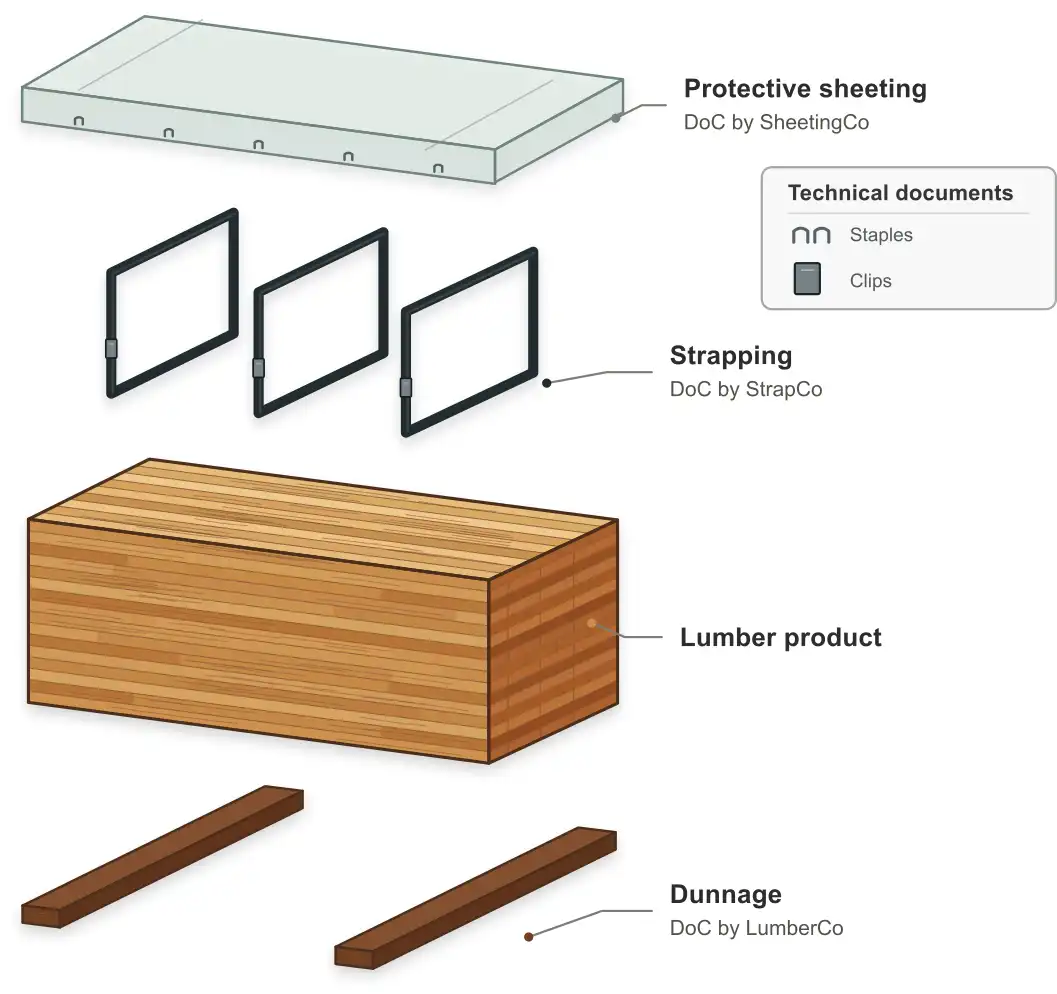
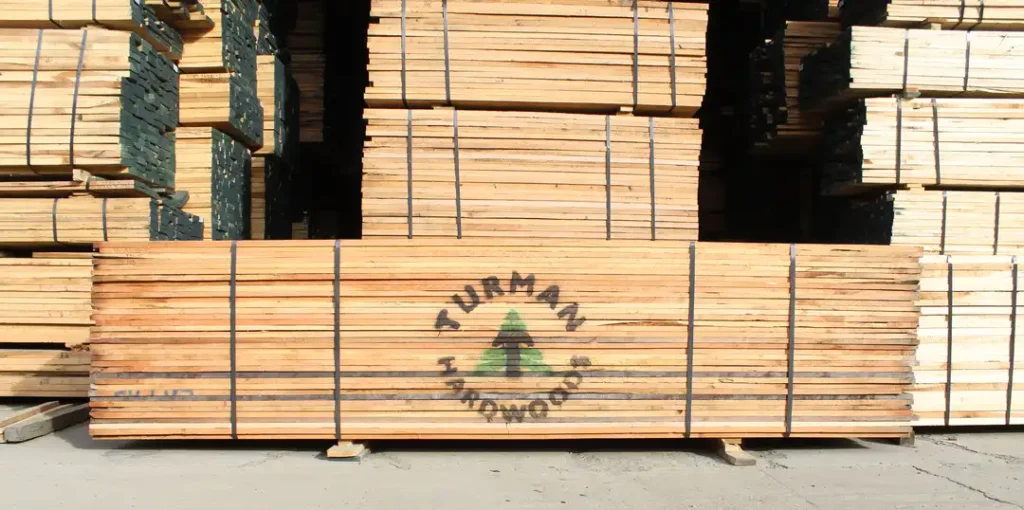
In this example, the lumber is the commercial product. The illustration separately presents protective sheeting with a DoC by SheetingCo, strapping with a DoC by StrapCo, and dunnage with a DoC by LumberCo. Staples and clips are not themselves packaging products, but may be used with packaging. Same as nails used in pallets. For those components that are used with packaging, technical documents must be obtained in order to meet some of the PPWR’s requirements. Requirements such as asserting that the heavy metal limitations, recyclability, etc. are compliant with PPWR.
What a U.S. company should create or collect
The silver lining is that new DoC’s and technical documents do not need to be regenerated for each shipped unit. Instead, they are reusable so long as the Packaging or the technical documentation does not change. Shrink wrap, nails, dunnage, etc. will normally remain the same so long as the Manufacturers of those items do not change their product; therefore Declarations of Conformity and technical documents will normally stay the same. If the product does change, a new assessment and DoC will be required. For reusable compliance packages:
- Choose one EU-bound configuration. Record what is physically shipped.
- Separate the product from the Packaging. Identify the items used to contain, protect, handle, deliver, or present the product.
- Identify each Packaging type and relevant component. Do not assume the entire load is one type, and do not assume every staple or clip automatically needs its own DoC.
- Identify the Manufacturer for each Packaging type. Where your company is the Manufacturer, it must assess the Packaging, maintain the technical documentation, and issue the DoC after conformity is demonstrated. Where another company is the Manufacturer, obtain that Manufacturer’s applicable DoC through the supply chain.
- Collect supporting supplier evidence. Specifications, composition information, drawings, test evidence, and traceability records may be needed in the technical file. A supplier document is useful evidence, but it does not automatically replace the Manufacturer’s DoC.
- Connect every document to an approved configuration. Record the Packaging name, Manufacturer, supplier, document number, revision, issue date, and the configurations in which it is used. Review the file when a relevant material, design, supplier, manufacturing process, or legal requirement changes. [1, arts. 15–16 and 39]
We use PPWR Compliance File as a practical name for this controlled collection. PPWR does not define a separate document by that title. A useful file brings together three layers: the applicable Manufacturer Declarations, the supporting technical evidence, and configuration records in the form of a cover letter showing which documents apply to the Packaging actually supplied.
Customers, importers, distributors, and other downstream participants may need the applicable DoCs and other information to perform their own PPWR duties. A company should maintain a controlled customer-facing set of compliance documents.
Start with one shipment you understand
Choose one recurring EU-bound shipment and diagram it. Beside every Packaging type, identify who the Manufacturer is, whether your company must create or obtain the DoC, what supporting evidence is available, and which approved configuration the document covers.
Make the system repeatable. If you have standard shipping configurations, you can easily create your own compliance file for each configuration and save yourself from repeating the same work for each shipment. Once you have your compliance files setup, you only need to ensure it stays up to date.
What if the packaging doesn’t have a brand name or you’re unclear as to who is actually the Manufacturer responsible for the Declaration of Conformity? When a product is not branded, the Manufacturer is the one who “…places the order and determines the specifications…” of the packaging according to the Commission’s Guidance. This will be covered in more detail in the next article.
This article is educational and reflects the official PPWR sources current as of 17 August 2026. It is not a substitute for company-specific analysis or advice from qualified legal counsel.