
When an unbranded pallet does not identify its PPWR Manufacturer by appearance alone, the European Commission’s Guidance distinguishes between generic Transport Packaging supplied from stock and custom Packaging produced to specifications controlled by the ordering company. That distinction assigns responsibility for the compliance assessment, technical documentation, and EU Declaration of Conformity.
Other Packaging in the same shipment – shrink wrap, bubble wrap, strapping – may each need their own DoC issued by each relevant Manufacturer.
PPWR uses Transport Packaging for items used to contain, protect, handle, or deliver products during shipping. The EU Declaration of Conformity, shortened to DoC, is signed by the PPWR Manufacturer: the company legally responsible for showing that the identified Packaging meets the applicable requirements. The compliance assessment checks the Packaging against those requirements. The technical documentation contains the specifications, material information, tests, calculations, and production records supporting the assessment. [1, art. 3(1), point (7); arts. 15-16 and 38-39; Annexes VII-VIII]
Our first PPWR article explains how one shipped unit can involve several DoCs and supporting records. This article addresses who is responsible for those documents when the Packaging does not display an obvious customer brand.
This article is based solely on our reading of Regulation (EU) 2025/40, the European Commission’s published Guidance, and the official PPWR FAQ. It is intended to help readers understand how those sources address unbranded Packaging, Manufacturer responsibility, DoCs, and supporting evidence. It is educational and does not constitute legal advice or a company-specific determination. Readers should review the official sources and seek qualified advice before assigning responsibility in their own supply chain.
Who is responsible for an unbranded pallet
For unbranded Packaging, the Commission looks at who places the order and who decides the design specifications. A standard pallet purchased from stock and a custom pallet built to a customer’s controlled design can therefore have different PPWR Manufacturers. [2, topic 2; 3, sec. II, question 5, and sec. X, question 14]
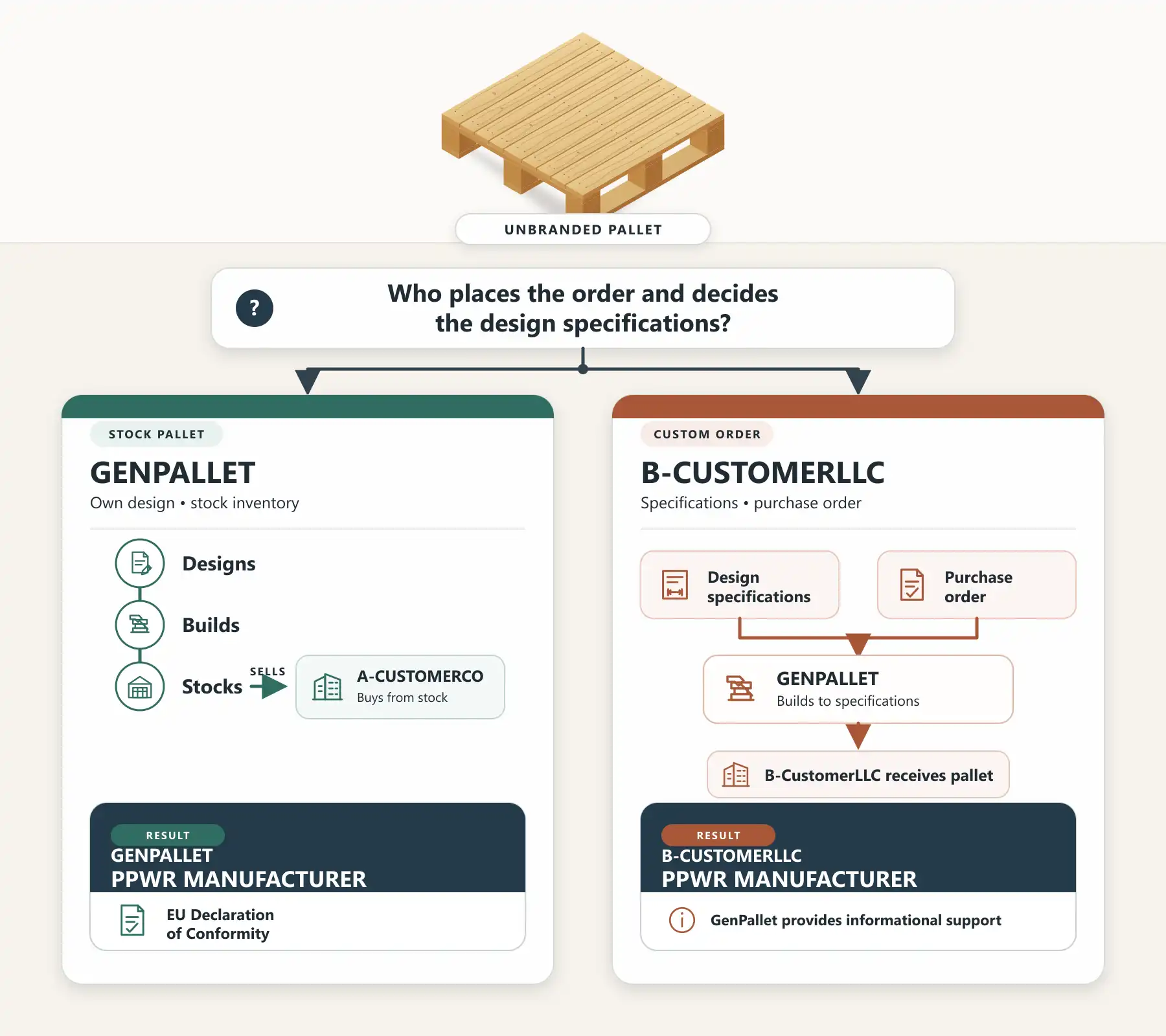
In the stock-pallet example, GenPallet designs the pallet, manufactures it, holds it in inventory, and sells it to A-CustomerCo. The Commission FAQ normally assigns Manufacturer responsibility for generic unbranded Transport Packaging to the company that physically makes it. GenPallet assesses the pallet, maintains the supporting technical documentation, and issues the DoC. [3, sec. II, question 5]
In the custom-pallet example, B-CustomerLLC orders a pallet for its product and controls the design specifications. The FAQ assigns Manufacturer responsibility to B-CustomerLLC in that arrangement. GenPallet builds the pallet to the controlled specifications and provides the information and records B-CustomerLLC needs to assess it. B-CustomerLLC maintains the technical documentation and issues the DoC. [1, art. 16; 3, sec. X, question 14]
A purchase order for a standard stock pallet does not transfer Manufacturer responsibility to the customer. The custom result applies when the order is for custom-made Packaging and the customer controls its design specifications. Narrow PPWR provisions for some micro-enterprise arrangements can change the result; the infographic does not depict those arrangements. [1, art. 3(1), point (13)(b), and art. 15(12)]
Unbranded describes the commercial arrangement used to identify the responsible company. Article 15 still requires the Manufacturer’s name and contact information on the Packaging, through an allowed digital carrier, or in an accompanying document where permitted. [1, art. 15(5)-(7)]
The pallet DoC covers the finished pallet
The DoC in these examples covers the finished pallet. The lumber, nails, paint, coating, or treatment used to build it are addressed through the pallet Manufacturer’s compliance assessment and technical documentation rather than through a separate pallet DoC for every part.
Annex VII requires the technical documentation to identify the Packaging and its intended use. Where applicable, the file also covers the design, manufacturing drawings, component materials, technical specifications, assessments, test reports, and production controls. [1, Annex VII]
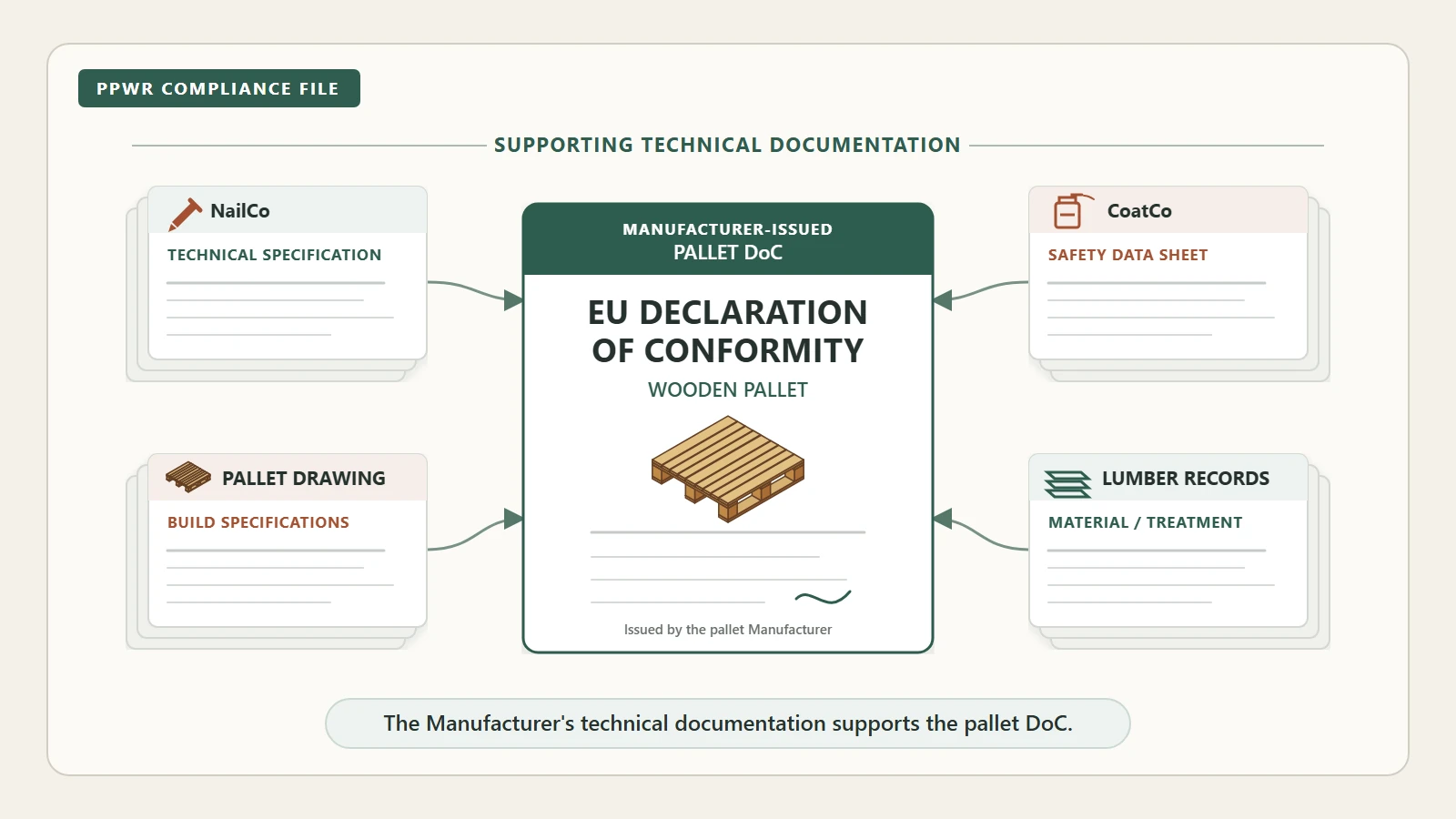
For a wooden pallet, the supporting records may include:
| Pallet Elements | Records that may support the pallet assessment |
|---|---|
| Finished pallet | Pallet drawing, dimensions, intended use, build specification, production controls, and relevant tests or calculations. |
| Lumber | Lumber specifications and appropriate purchasing or traceability records. |
| Nails | The nail Manufacturer’s technical specifications and relevant composition or coating information. |
| Paint or coating | Product specifications and composition information needed for the applicable assessment. |
| Chemical treatment, when used | Treatment specifications, process information, and records from the chemical supplier. |
A Safety Data Sheet, commonly called an SDS, may provide useful information about paint, coatings, or chemical treatments. It does not show by itself that the finished pallet meets PPWR. A heat-treated pallet should not be documented as chemically treated.
The pallet Manufacturer uses relevant supplier and component records as evidence for the finished pallet. The nail specification remains a nail-supplier record, and an SDS remains a chemical-product record. Neither becomes a separate pallet DoC or part of another company’s signed Declaration.
Finished Packaging products may require separate DoCs
The Commission FAQ treats stretch wrap sold on a roll as Packaging in its final form because it is already ready to stabilize a palletized load. Cutting the wrap from the roll and applying it to a shipment does not make the company using it the Manufacturer. For generic unbranded wrap, the company that manufactures and places the wrap on the market as Packaging issues the DoC. [3, sec. II, question 5]
The same approach applies when strapping, bubble wrap, shrink wrap, or protective sheeting is purchased as a finished Packaging product. Each product has its own Manufacturer, and the company using it obtains the applicable DoC through its supplier. The supplier may be a distributor rather than the Manufacturer named on the DoC.
The FAQ identifies pallets, wrappings, and straps as different Transport Packaging types requiring separate compliance assessments and separate DoCs. [3, sec. XV, question 11]
A finished Packaging product can still contain supporting components. Buckles, seals, or clips may be covered within the technical documentation for a defined strapping system instead of receiving separate DoCs. The strapping Manufacturer’s documentation identifies what its assessment and DoC cover.
A custom order can assign responsibility differently. A company that orders custom unbranded wrap, sheeting, or strapping and controls its design specifications may become the Manufacturer under the same Commission analysis applied to the custom pallet. The contract, specifications, and actual product determine the result.
Organizing the compliance records
Each recurring EU-bound Packaging configuration should identify the finished Packaging used, the Manufacturer responsible for each type, and the records supporting the determination.
| Packaging or record | Responsibility in the examples |
|---|---|
| Standard unbranded pallet purchased from stock | The pallet company normally issues the pallet DoC. |
| Custom unbranded pallet built to customer-controlled specifications | The ordering customer issues the pallet DoC and obtains supporting information from the pallet builder. |
| Finished wrap, strapping, bubble wrap, or protective sheeting | The Manufacturer of each Packaging product issues its applicable DoC. |
| Lumber, nails, coatings, treatments, clips, or seals used within a defined Packaging type | Supplier and component records support the relevant Manufacturer’s technical documentation. |
| Packaging configuration record | The company using the Packaging records which current DoCs and supporting records apply to the materials and designs actually used. |
When a U.S. company is the PPWR Manufacturer, it assesses the Packaging, maintains the technical documentation, and issues the DoC. When another company is the Manufacturer, the U.S. company obtains that company’s DoC and keeps the records required for its own role in the supply chain.
These documents can be maintained together in a PPWR Compliance File. We use that term for the controlled collection of current DoCs, technical and supplier evidence, and records showing which documents apply to each Packaging configuration. PPWR does not define a separate document by that name.
This article is educational and reflects the official PPWR sources reviewed on 18 August 2026. It is not a substitute for company-specific analysis or advice from qualified legal counsel.